Services
From Your Drawing To An Inspected Shipment.
OEM and ODM industrial blade production, custom sizes and materials, logo marking, samples and batches — including the non-standard work nobody else wants to take on.
Speak our language
The Words That Turn Your Enquiry Into The Right Blade.
Blade quoting goes wrong when two sides mean different things by the same word. Work through the terms below and give us the ones you know — every answer removes a round of questions and gets you a firmer price.
Click any diagram to enlarge it.
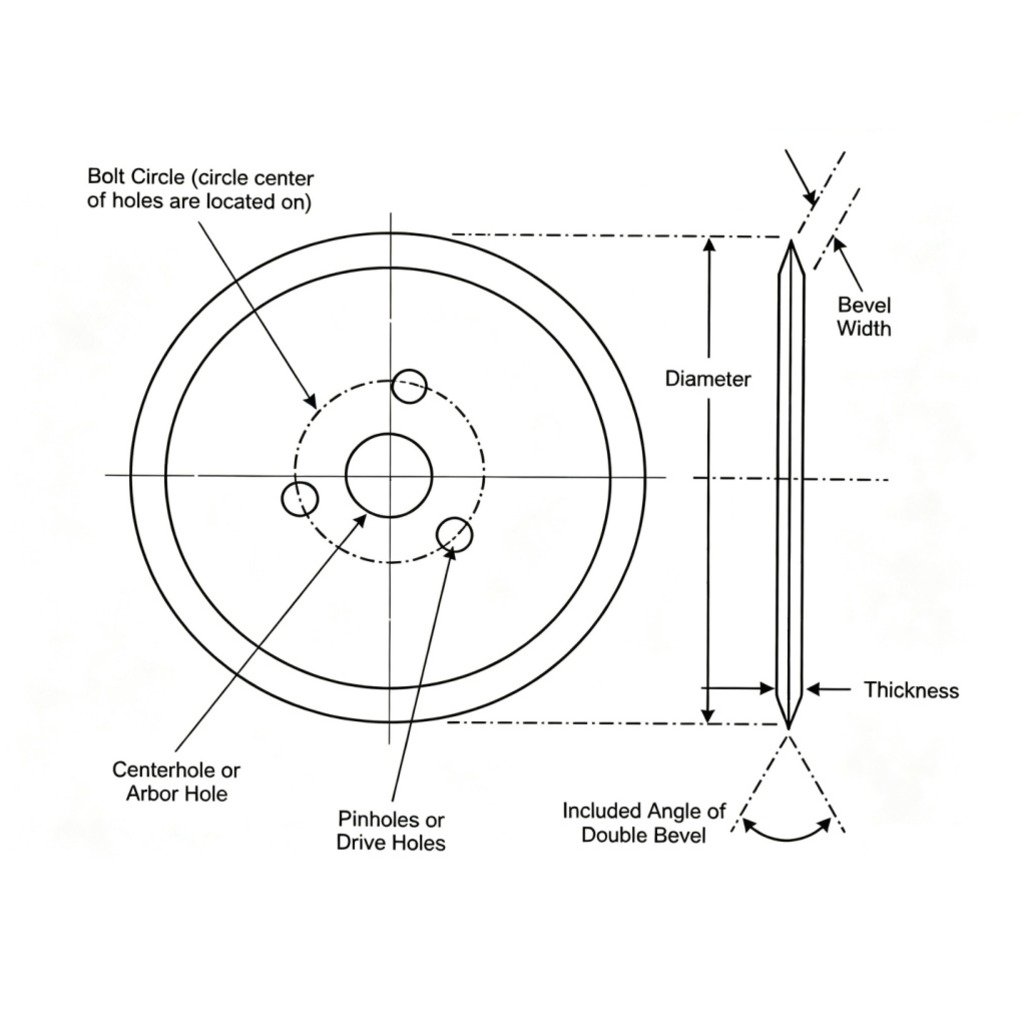
Anatomy of a Circular Blade
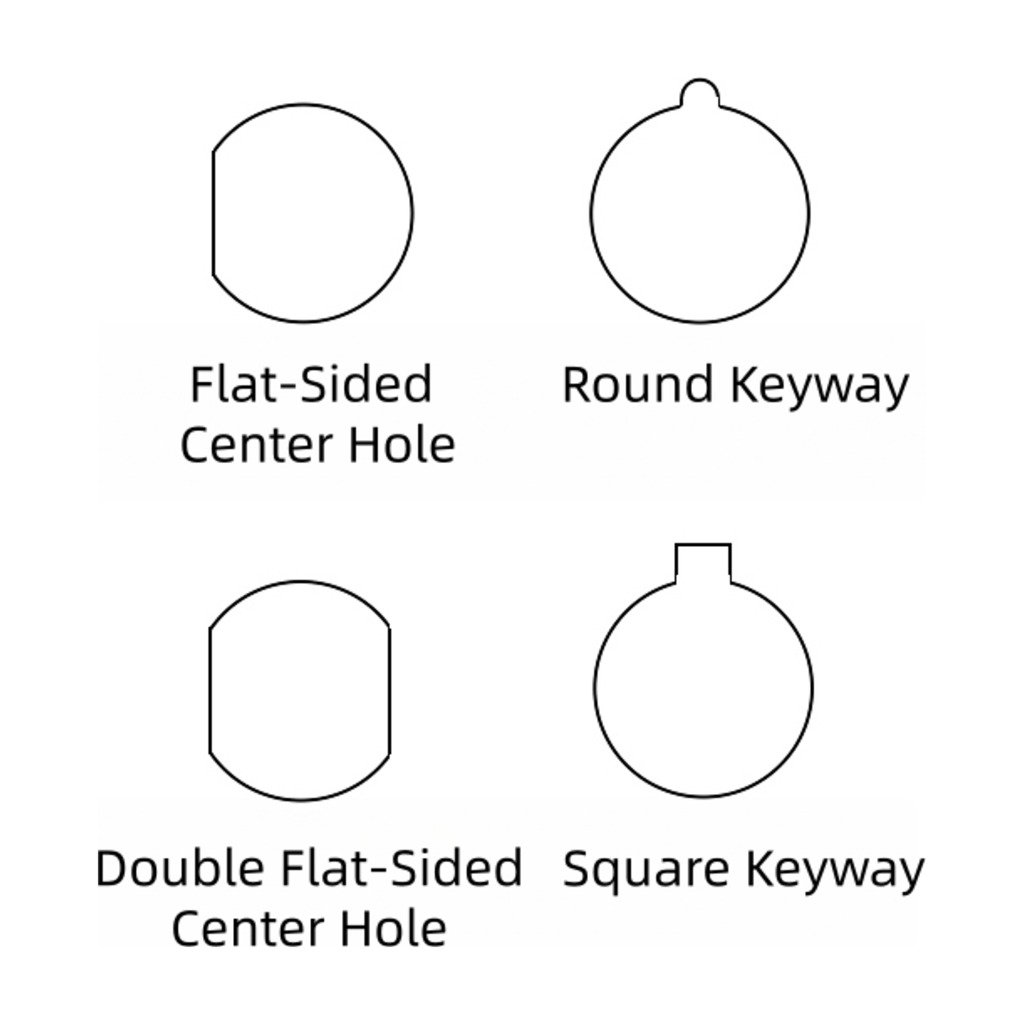
Arbor hole
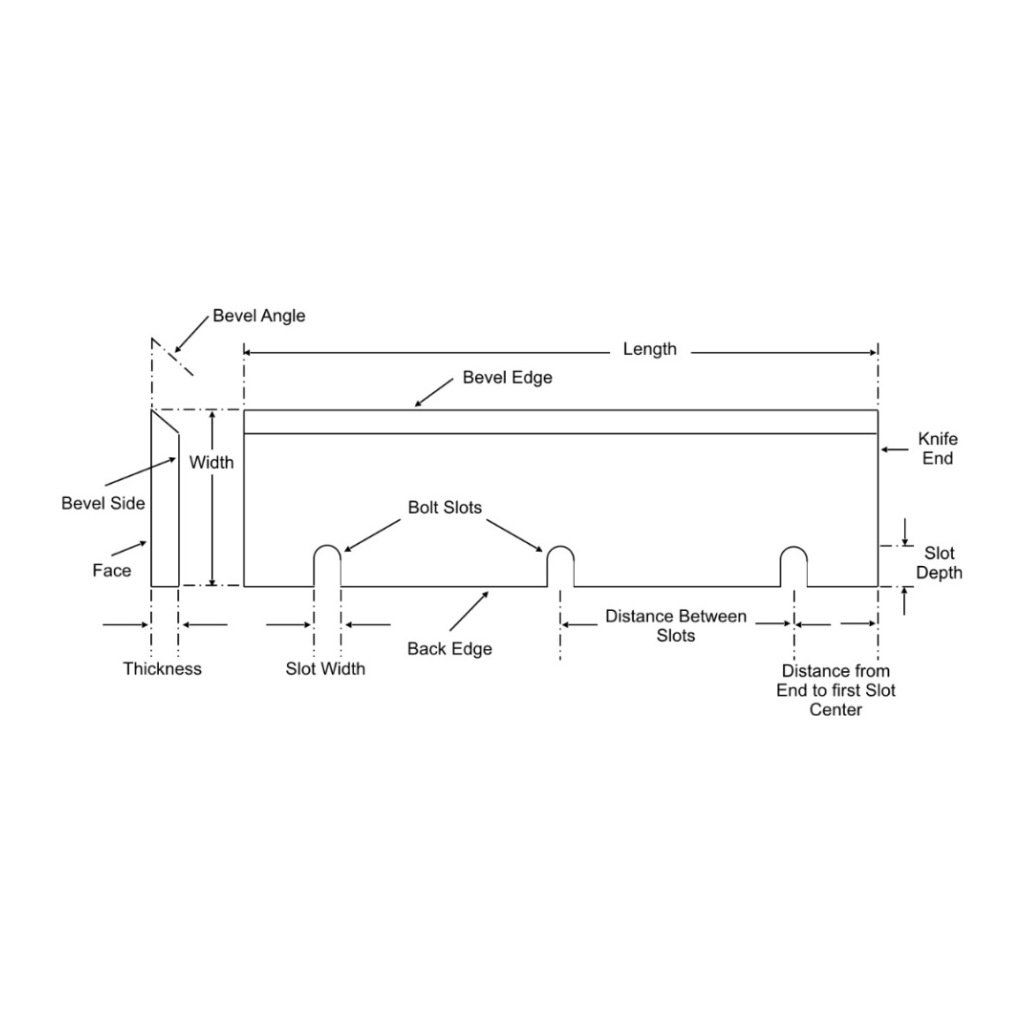
Anatomy of a Straight Blade
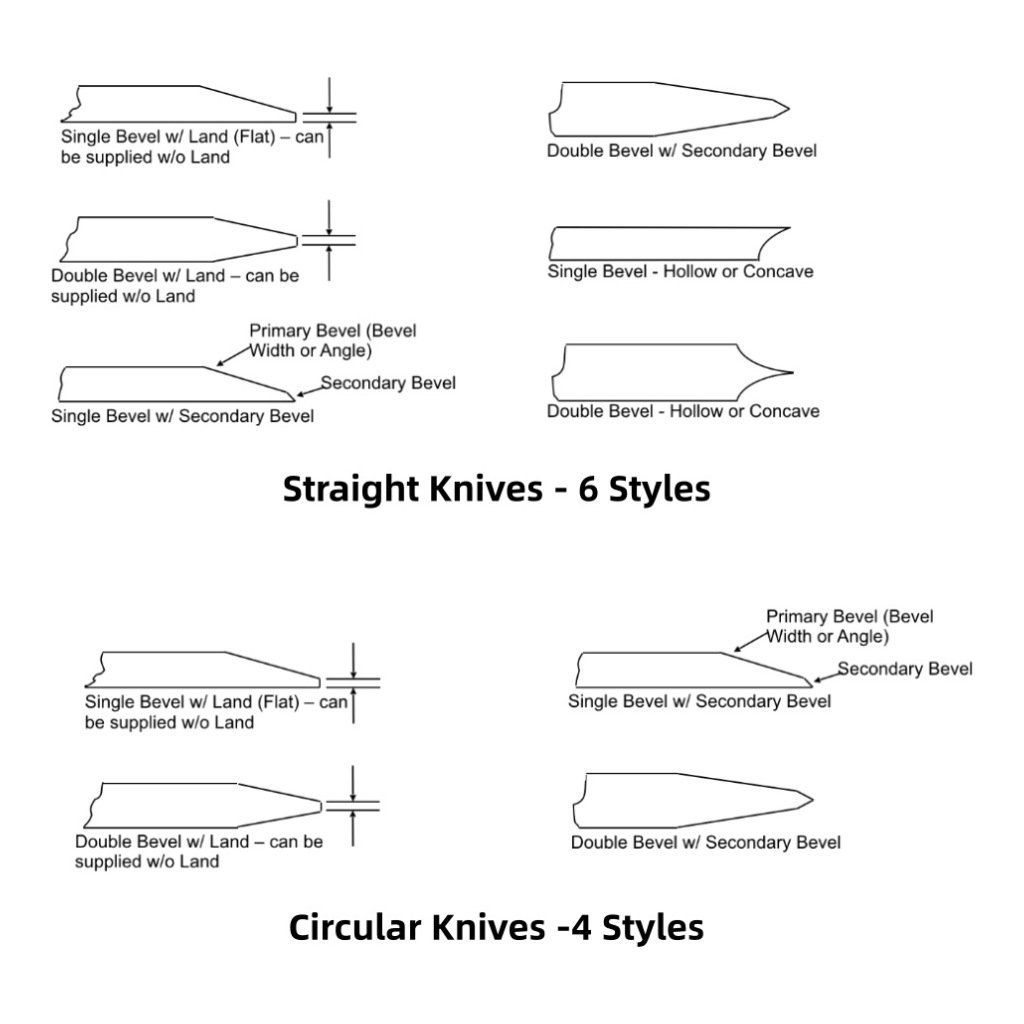
Bevel
Circular blade dimensions
- Outside diameter
- Full disc size, edge to edge
- Bore / arbor hole
- Centre hole that fits the shaft
- Drive holes
- Off-centre holes that turn it
- Bolt circle
- Circle those holes sit on
- Thickness
- Blade body thickness
Give us all four numbers and the blade will fit your machine first time. If you only have the worn blade, measure OD, bore and thickness.
Straight blade dimensions
- Length
- Overall knife length
- Blade width
- Cutting edge to back edge
- Bottom edge
- The unsharpened back
- Bolt slots
- Mounting slots or holes
- Thickness
- Body thickness
Slot positions matter as much as length — a knife that is 1 mm out on the slot centres will not mount.
Edge and bevel
- Bevel
- Ground face forming the edge
- Bevel angle
- Angle off the blade plane
- Bevel width
- Ground land, edge to body
- Single / double
- One or both sides ground
- Compound bevel
- Two angles, tougher edge
A shallow angle cuts more cleanly; a steeper one lasts longer. Tell us which you are short of and we will pick the trade-off.
Edge profile
- Plain
- Straight, continuous edge
- Serrated / toothed
- Any toothed edge
- Tooth pitch
- Teeth per inch, or centre spacing
- Scalloped
- Overlapping semicircular bevels
- Notched
- Partial cut, tear-open lines
For serrated packaging knives, tooth pitch decides whether the pack tears where it should. Send a sample or a photo against a rule if you do not know it.
Material properties
- Hardness
- Resistance to deformation, HRC
- Toughness
- Resistance to chipping
- Edge retention
- How long it stays sharp
- Corrosion resistance
- Rust and wash-down resistance
- Tempering
- Heat treatment for toughness
Hardness and toughness pull against each other. Tell us the failure you see — dulling, chipping or rusting — and the grade follows.
Accuracy and finish
- Run-out
- Blade off the axis of rotation
- Hop
- Disc not perfectly round
- Twist
- Knife not flat or straight
- Burr
- Metal left after grinding
- Coating
- TiN, TiAlN, DLC, PTFE
If your web edge is dusty or the pack is tearing raggedly, the cause is usually run-out or a burr — not the steel grade.
Material selector
Which Blade Material Actually Pays For Itself?
A comparison our customers usually have to assemble themselves. Use it to sanity-check the grade you are being offered — then send us the application and we will confirm it.
| Material | Typical hardness | Best for | Relative edge life | Relative cost | Regrind |
|---|---|---|---|---|---|
| Tool steel D2 / SKD11 | HRC 56–60 | Paper, board and general industrial slitting | Baseline | Lowest | Many cycles |
| High speed steel M2 / M35 | HRC 58–60 | Fast circular knives, hot-running packaging blades | 2–3× | Moderate | Many cycles |
| Powder metallurgy steel | HRC 56–60 | Filled plastics, laminates, tough recycling duty | 3–5× | High | Good |
| Tungsten carbide | HRA 88–92 | Abrasive film slitting, nonwoven, long runs | 10–30× | Highest | Specialist grinding |
| Stainless 440C / food grade | HRC 50–56 | Meat, poultry, seafood, wet food-contact lines | Application-led | Moderate | Good |
| Coated steel (TiN / TiAlN / DLC) | Substrate + coating | Sticky films, adhesive tape, release-critical cuts | 1.5–3× | Moderate | Recoat needed |
Edge life multipliers are indicative and depend on material abrasiveness, line speed and blade support. We will tell you when a cheaper grade is the right answer.
What we do for you
Six Services, And What Each One Removes From Your Workload.
OEM / ODM Production
Blades produced as fitted components or aftermarket spares for your machines, under your brand, with your documentation. We stay invisible to your customer.
Size & Material Customisation
Any diameter, length, thickness, bore, hole pattern, bevel angle, hardness range or coating. The application decides the specification, not a stock list.
Logo & Private Label
Laser marking of your logo, part number and batch code, plus printed sleeves and cases so distributor stock arrives shelf-ready.
Sample Production
One piece is enough to start. Trial blades are made on the production route we would use in series, so a good sample means a good batch.
Batch & Blanket Orders
Serial production with scheduled releases, so your working capital is not sitting in a warehouse and your line never waits for steel.
Non-standard Production
One-off sizes, discontinued machines and unbranded blades are routine work here. Send the specification and we will quote it.
How we behave
Four Commitments We Will Put On Paper.
We state the numbers
Dimensions, materials, and plating information will be included in the quotation. If we cannot hold a number, we say so before you order rather than after.
We hold the process
Every approved part number is tied to a fixed route. Reorders are produced to the same recipe, so the tenth batch behaves like the first.
We take the awkward work
One-off sizes, obsolete machines, unbranded imports and non-standard geometry are ordinary requests here, not exceptions.
We answer quickly, in English
Enquiries are answered within one working day by someone who can discuss the application, not only the price.